Event 1
Discovery of Multiple Bodies at a Pudong Construction Site

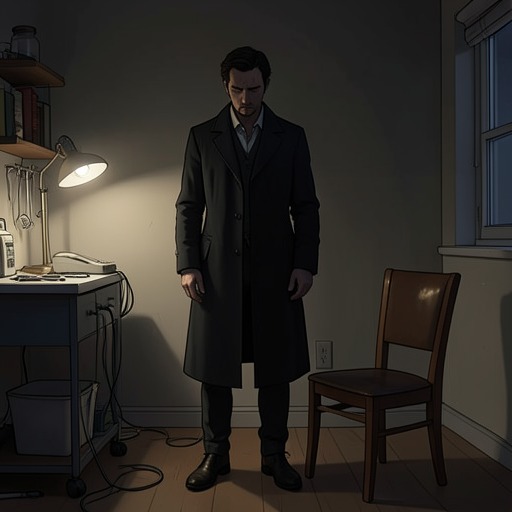
The [Discovery of Multiple Bodies at a Pudong Construction Site](entity:event-recall-event-c76ba62df98d) begins as a carefully staged celebration of financial ambition and becomes the public exposure of a grave crime. At a foundation ceremony for the [New York-Shanghai Bank construction site](entity:location-recall-location-2d6ff93796d1), a collapse sends the American bank’s chief executive into the excavation, where buried human remains emerge from the mud. The accident forces a hidden crime into view before officials, witnesses, and international media.
## Ceremony and discovery
The ceremony was meant to mark a new beginning: the American executive, newly assured that his position would make him one of the world’s most powerful men, stood ready to release a hopper of concrete into the bank’s foundations. His Chinese counterpart approached the microphone as rain fell over the site. With television lights and cameras trained on the platform, the event joined commercial spectacle to an ambitious construction project.
As the executive pulled the lever, the waterlogged trench and the boards beneath the small platform gave way. He fell into the mud. The collapse exposed human remains embedded in the trench walls, transforming the ceremony into an emergency witnessed by the assembled officials and press. What had been presented as a confident beginning for the bank was abruptly overshadowed by the discovery of multiple bodies at its foundations.
## Public exposure and recovery
The discovery immediately became an international crisis as well as a police investigation. The ceremony had been carried live by satellite, and the presence of Western television crews meant the find could not be contained as a local construction-site incident. Officials feared that the bodies in the bank’s foundations would damage the project’s prospects; American representatives were reportedly considering withdrawal from the joint venture. The victims’ remains and the commercial deal were thus forced into the same public frame, though the investigation treated the human cost as the central matter.
At the site, armed guards controlled the gates while police and forensic teams worked beneath floodlights in the cold mud, searching for further remains. More than two dozen police and forensic vehicles gathered outside. Because the excavation was still underway, investigators used the basement car park of a nearby office tower as a temporary work area. There, on more than twenty tables, they laid out recovered pieces and recorded what had been found and what was still missing, an improvised system that made the scale of the task visible without yet establishing how many complete bodies could be reconstructed.
The remains were identified initially as belonging to women, with the victims’ ages estimated from the late teens to the early thirties. The condition of the evidence complicated both identification and matching: decomposition had progressed, and investigators could not reliably determine which pieces belonged together by sight. They compared bone ends and sent samples of skeletal muscle for DNA analysis, while the pieces were kept separate pending identification. The physical traces indicated that the victims had been dismembered after death, rather than killed by the later cutting. This distinction separated the cause of death from the subsequent handling of the bodies and directed attention toward how they had been processed and concealed.
The cold condition of the remains supplied an approximate sequence, but not a precise time of death. Forensic examination found signs of freezing, and the bodies appeared to have been buried while still frozen. Since the burial was only about two or three feet below the surface and the densest parts had not fully thawed, the investigators estimated that burial had occurred roughly four or five days before discovery. The estimate remained provisional; the freezing and later thawing made the victims’ time of death impossible to determine with confidence. The construction site therefore yielded not a simple timestamp but a chain of post-mortem handling that the investigation would have to reconstruct.
## Later examination and the wider pattern
Months after the discovery, a further examination revisited one of the young women’s remains. By then, the body had undergone the initial post-mortem examination, eight months in frozen storage, and four days of thawing. These successive stages had further obscured its features, making the later investigation depend on procedural traces rather than appearance.
The examination found evidence that the woman had been alive when an organ-removal procedure began, connecting her case to the [Shanghai](entity:location-recall-location-cfb85ff27bb7) victims. Yet the cases were not identical: her lungs, one kidney, and eyes remained, and her bones had been sawn through rather than chopped. A blue polypropylene suture, tied in a distinctive knot and also found in most of the Shanghai victims, provided a shared clue. Despite the differences in how the bodies had been treated, Margaret Campbell concluded that the same person had probably killed the woman. The construction-site discovery thus became part of a broader investigation into repeated surgical killings, while the remaining distinctions pointed to variation in the circumstances of the crimes.
## From Discovery to Forensic Pattern
The site’s significance extends beyond the number of remains recovered: it provides the first material link between a mass burial and a sequence of surgical killings. That link emerges through comparison rather than a single decisive resemblance. Freezing, burial, decomposition, and later examination altered the evidence, while the different treatment of particular bodies cautioned against assuming that every procedure had been identical. Margaret Campbell’s conclusion that one woman had probably been killed by the same person, despite those differences, turned the discovery into evidence of a broader pattern without erasing the uncertainties that remained. The investigation’s central movement is therefore from a public accident that exposed concealed remains to a more qualified reconstruction of how those remains had been handled and how separate cases might be connected.
Event 2
Li Yan Appointed to Lead the Shanghai Body Case Investigation

## The Appointment and Its Stakes
The appointment comes during a conversation with [Director Hu](entity:character-recall-character-director-hu-2a0a2dc3e73a), with [Huang Tsuo](entity:character-recall-character-huang-tsuo-15b2ce8a4fec) present and largely silent. The adviser describes the case as a severe embarrassment because it has been broadcast around the world, and warns that the publicity could damage [Shanghai](entity:location-recall-location-cfb85ff27bb7)’s inward investment. He wants a prominent solution quickly, achieved under the same public scrutiny that has exposed the crime. The emphasis falls not only on the victims or the investigation’s demands, but on the city’s reputation and economic confidence.
Li is careful not to claim certainty. Asked for his thoughts, he says it is too early to reach conclusions. The adviser accepts the restraint, then makes clear that the mayor wants Li to take charge. Li initially says he will need permission from his superiors in [Beijing](entity:location-recall-location-33e16fa9a866). Director Hu answers that the arrangement has already been approved by Beijing’s police commissioner: Li has been lent to Shanghai for the duration of the investigation. The role is not an advisory one. The mayor wants him to lead the inquiry and holds him personally responsible if it does not reach a satisfactory conclusion.
That condition changes the meaning of the appointment. Li is given authority, but also made the visible bearer of failure in a case already defined by public exposure. He recognizes that his presence has stirred resentment in Huang and that [Yue](entity:character-recall-character-yue-10146f3856ab), the procurator general, is similarly cool toward him. The task therefore begins with both external pressure and internal friction: Li must produce results while working among officials who have reason to regard his elevation as an intrusion.
## Campbell as a Forensic and Public Choice
Li’s first request is to employ Margaret Campbell, an American pathologist. He explains that pathology will be paramount given the nature of the case, and argues that Campbell has far more experience than [Dr Lan](entity:character-recall-character-dr-lan-c986e9e04685). His reasoning is practical: the investigation requires specialized expertise, and Campbell has worked in [China](entity:location-recall-location-134e6ca3a450), so she understands how the local system operates.
The request also answers the political circumstances Director Hu has described. Li points out that a high-profile Chinese-American collaboration would be good public relations. His proposal therefore joins forensic judgment to the demand for a public-facing resolution: Campbell is valuable as an experienced pathologist, and her involvement can present the inquiry as capable of bringing international expertise to bear. Huang begins to object, but Director Hu silences him and asks Li to justify the request. After hearing the case, Hu agrees that Huang and Yue will facilitate Li’s requirements. The exchange establishes that Li’s leadership will involve negotiation as well as investigation.
## The Investigation’s Early Reasoning
As the inquiry proceeds, Li’s position requires him to distinguish suspicion from proof. In one discussion, he considers whether a night watchman might be implicated, but warns that the apparent simplicity of the theory could itself be misleading. He also entertains the possibility that the crimes reflect a disturbed individual, recalling Campbell’s half-serious allusion to a psychopathic surgeon. The suggestion remains a possibility, not a conclusion.
[Detective Dai](entity:character-recall-character-detective-dai-3eb849322b23) then raises a practical difficulty: if the victims were operated on while alive, someone else may have been administering midazolam and using an Ambu bag. Li acknowledges that he had not considered this. The implication shifts the working picture from a solitary perpetrator toward a possible collaboration, even as the number and identity of those involved remain unknown. Li does not allow that speculation to displace what he treats as the immediate priority: identifying the victims as quickly as possible. His response reflects the discipline required by his appointment: alarming hypotheses matter, but they must not replace actionable investigative work.
## From Victims’ Names to a New Clue
The investigation’s demand for identification later becomes personal through the account of [Chai Rui](entity:character-recall-character-chai-rui-ae87dc17efed), a twenty-two-year-old known as Cherry. Li tells Campbell that she had worked as a club hostess, lost that job after her drug use became known, and had a young daughter whose whereabouts were unknown. A box of belongings was all that remained of a life that had previously been only one unidentified case among the bodies.
Campbell’s reaction shows what identification changes. Knowing a victim’s name and that she had a child makes the loss harder to keep at a professional distance. At the same time, the new detail redirects her attention: she realizes that the fact Chai Rui had a child may matter to the pattern connecting the victims. She admits that too much information had obscured the obvious, and compares the lapse to a bus-driver riddle in which attention to numbers and stops hides what is already in view. Beside the autopsy table, she asks Li to look again at the evidence and consider what connects the women beyond coincidence.
The appointment does not itself solve the case, but it establishes the conditions under which that recognition can emerge: an inquiry led by Li, supported by Campbell’s pathology, and pressed to identify individuals rather than reduce them to a public scandal. The case’s political visibility makes speed and reputation unavoidable concerns; its progress depends on resisting the same narrowing pressure and attending to the details that give the victims’ lives investigative meaning.
Event 3
Margaret’s Father’s Sudden Death
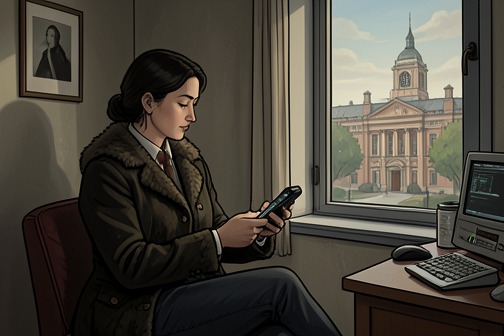
Margaret Campbell’s father’s sudden death is an offstage event whose force unfolds through its delayed effects: it brings grief to the surface after an initial numbness and breaks the fragile ties keeping Margaret in [China](entity:location-recall-location-134e6ca3a450). His unexpected death also leaves her facing decisions about where her future lies, decisions she had long avoided.
## Circumstances and Distance
Margaret’s father drops dead in his university lecture room from a massive coronary thrombosis. His death is quick and painless, and completely unexpected. The abruptness offers no preparation for those left behind; Margaret recognizes that what might seem the best way to die for the person who dies can be devastating for the people who must absorb the loss.
At the time, Margaret is in [Beijing](entity:location-recall-location-33e16fa9a866). Her mother conveys the news in a short, cold phone call. Margaret has not seen her father for nearly two years, and their contact has dwindled to a handful of phone conversations. The physical distance mirrors a relationship already marked by absence, but it does not prevent the loss from becoming a turning point in her life.
## Grief That Arrives Later
After hearing the news, Margaret sits for a long time in the small apartment provided by the [Public Security University](entity:organization-recall-organization-4452283055a4). She is disturbed by the emptiness she feels and by the possibility that she may not be grieving. The emotion arrives only later: she wakes in the middle of the night with tears of her own, discovering a sorrow that her first reaction had concealed rather than disproved.
This delay shapes the event’s emotional meaning. The death is sudden, but Margaret’s recognition of grief is not immediate. Her response emerges in a private moment after the call, when there is no one else to witness it. The gap between her apparent numbness and those later tears makes bereavement something she must discover within herself.
## The Funeral and the Empty Room
On the day her father is buried, Margaret cannot bear to look at his body in the coffin. The mortician has carefully colored his face to suggest life, but she cannot accept the body as her father; to her, he has already vanished, remaining only in other people’s memories and in flickering old home-movie images. Family photographs offer little comfort, seeming to preserve moments without the personality that gave them life.
While laughter and the clink of glasses rise from the wake, Margaret resents the guests’ apparent lightness on the day of the burial. She withdraws to her father’s den, shuts the door, and listens to the silence. The room has been left as it was when he died, its heavy curtains dimming the late-afternoon light. There, among the books he had read and marked, she can still sense the private life that has ended. His half-smoked pipe remains beside his desk; the teeth marks around its mouthpiece and the familiar tobacco scent connect the untouched room to habits that will not resume.
## The Life His Death Disrupts
The loss finally forces Margaret to break her ties with China. Those ties had been fragile, held in place only by a man she thought she loved. Returning home does not settle what comes next: it brings her back to decisions about her future that she has postponed and does not want to face.
For nearly three days after her return to [Chicago](entity:location-recall-location-73935e623d95), Margaret avoids her apartment in [Lincoln Park](entity:location-recall-location-61813c9c2b2a), where neighbors have been collecting her mail and watering her plants during her absence of more than eighteen months. Instead, she stays in her childhood bedroom in [Oak Park](entity:location-recall-location-204370f491b6), choosing its familiarity over the past associated with the man she had married. Her father’s death thus brings her home while leaving her unsure how to inhabit that home or what future to choose; even amid the wake and the objects preserved in his den, she recognizes that retreat is not the same as resolution.
Event 4
Genetically Contaminated Rice Warning

The [Genetically Contaminated Rice Warning](entity:event-recall-event-87f6b845428f) was an online warning issued by American pathologist Margaret Campbell about genetically contaminated rice. It had become a worldwide news story eighteen months before the [Shanghai](entity:location-recall-location-cfb85ff27bb7) investigation, giving Margaret a public profile that unexpectedly resurfaced when she was invited to assist the authorities. The novel supplies no details about the warning’s claims or its outcome; instead, it shows how the episode lives on through news coverage and other people’s recollections.
## The Warning Becomes Public
The scale of the controversy is conveyed through a television report that identifies Margaret as an American pathologist who had previously worked with police in [Beijing](entity:location-recall-location-33e16fa9a866) and had drawn worldwide headlines for warning about genetically contaminated rice. The report uses a stock photograph taken when she assisted with autopsies at Waco. Margaret initially finds the face on screen disconcertingly familiar, then recognizes it as her own, several years younger. The warning is thus attached not only to her name but to an earlier image of her professional life, replayed as part of a public account of who she is.
The report introduces Margaret while announcing that Shanghai’s authorities have taken the unusual step of publicly inviting her to help with their investigation. It also says that the body count has risen to eighteen. The juxtaposition places her earlier headline-making warning beside a new crisis unfolding in Shanghai, but the report does not say that the rice controversy caused the invitation. Margaret wonders why the authorities would ask for her help; only then does she think of Li and his recent emails. The warning establishes her public visibility, while Li’s message explains how she learned of the invitation.
## Reputation and Personal Memory
The episode’s reach appears again in Margaret’s conversation with [David Webber](entity:character-recall-character-david-webber-4334ff4b3122). He tells her he read about her when the rice warning was in the news and recalls that it frightened him; he jokes that the coverage nearly put him off sushi for life. Margaret answers with a nod rather than a fuller account. His response measures the story’s passage from public controversy into ordinary conversation: the warning was alarming enough to remain vivid to him, yet it also became a subject for a personal joke.
Together, the television report and David’s recollection establish that the warning was not a passing local notice. It had circulated widely, attached Margaret’s name to a contentious public issue, and become part of how people recognized her. The book does not specify the rice involved, the evidence behind her warning, or any practical consequences for food safety, so the event’s documented importance rests on its publicity and on the reputation it helped create.
## A Pattern of Public Challenge
The warning also provides an earlier instance of Margaret speaking out before the novel places her in another politically charged debate. At a banquet in Shanghai, she condemns the one-child policy as draconian and barbaric, rejects the use of forced abortions, and accuses [Cui Feng](entity:character-recall-character-cui-feng-843c7ee06fee) of profiting from other people’s misery. These later confrontations are not presented as consequences of the rice warning, and the subjects are distinct. Their juxtaposition instead makes the earlier episode part of a broader portrait of Margaret: she has already attracted worldwide attention for a public warning, and in Shanghai she again refuses to soften her judgment when challenged by people with institutional or political standing.
The contrast between the two episodes is sharp. The rice warning reaches the reader retrospectively through television and David’s memory; the banquet disagreement is staged directly, with Margaret’s bluntness producing a shocked silence. In both, her public voice becomes consequential because it breaks into settings where others might prefer restraint. The warning therefore functions as more than background biography: it establishes that Margaret’s return to the news is not her first encounter with controversy, even as the novel leaves the warning’s technical details and wider material effects unstated.
Event 5
Xinxin's Abduction at Traffic Park

[Xinxin's Abduction at Traffic Park](entity:event-recall-event-xinxin-a8a82f5e720c) is the sudden disappearance of six-year-old [Xinxin](entity:character-recall-character-xinxin-7aebd94e5a79) during an afternoon with Margaret Campbell, an event that turns a place of play into the scene of a suspected kidnapping. Its defining reversal is measured in minutes: a child who had been laughing in a toy car is gone, and the ordinary explanations of a safe public park no longer hold. The search exposes a stolen workmen’s van and a puzzling report of a Westerner pursuing it, while the shock divides itself between Margaret’s guilt and [Li Yan](entity:character-recall-character-li-yan-3c97cde70b0f)’s fear for the child.
## A carefree afternoon becomes a search
The episode opens in the [Tiantan Traffic Park](entity:location-recall-location-f7ee2c0327ae), where children learn road rules by driving miniature vehicles along small streets and intersections. Xinxin grips the wheel of a little red plastic car, floors the accelerator, and sails through a red light, narrowly missing a boy on a blue motorbike and sidecar. Margaret laughs as she tries to explain the rules, but Xinxin’s concentration and delight matter more than instruction. On another circuit, she takes a roundabout the wrong way; Margaret suspects the girl knows perfectly well that she is meant to stop at red lights. Playful disobedience is part of the scene’s warmth, not yet a warning of danger.
The park’s carefully miniature world gives the afternoon its sense of safety. They pass paved paths, trimmed greenery, children’s rides, and models of [Shanghai](entity:location-recall-location-cfb85ff27bb7) landmarks, including the [Peace Hotel](entity:location-recall-location-98ef80f8a0df) with its pointed green copper roof. Elderly visitors and parents watch from benches as children steer cars beneath the misty sky. Near the entrance, figures of Goofy, Mickey Mouse, Donald Duck, and Pinocchio delight Xinxin. Margaret has to seize the wheel to keep the little car from mounting the sidewalk, then lets the girl continue driving. She feels unusually relaxed and affectionate, though the happiness also touches a private ache: her sense of loss for the child she might once have had.
## The disappearance
After several circuits, Margaret stops the car outside the toilet block and tells Xinxin to wait with it. Xinxin nods, and Margaret hurries to the ladies’ washroom. She is away for no more than about two minutes. When she returns, the car is gone from the spot and Xinxin has vanished. The surrounding park appears unchanged: children still shriek in the play area, adults talk, and people sit on the benches. That undisturbed normality sharpens Margaret’s panic. She calls Xinxin’s name, then yells it, running along the main street and searching for the familiar pink dress and bunches of hair.
At a parallel street about fifty metres away, Margaret finds the little red car abandoned near the area under development. Its wheels are turned hard left, but the child is not in it. An elderly couple she had noticed earlier remain on their bench. She runs to them and asks if they saw where Xinxin went, but they cannot understand her. At the car-return point, she glimpses a little girl with similar bunches sitting on a yellow motorbike and rushes over in relief. The child is a stranger, wearing a pale-green dress. When Margaret realizes her mistake, her hope collapses: she understands that Xinxin is not merely elsewhere in the park.
The park’s gate staff say they did not see Xinxin leave and believe they would have noticed. A middle-aged man who speaks some English helps raise the alarm, and police and park visitors begin searching. Rain falls as Margaret sits numb with shock. The scene’s emotional turn is stark: the attractions and Disney figures that had amused Xinxin now seem to mock the adults’ shattered confidence that the park was secure.
## The missing van and the uncertain witness
Li Yan reaches the park within twenty minutes of Margaret’s call. By then an hour has passed since Xinxin disappeared. He directs uniformed officers in a strained, increasingly urgent voice, while Margaret believes that he blames her. She blames herself too, thinking that a six-year-old should never have been left alone. The officials’ search is therefore also a contest with time: the evidence must distinguish a child who has wandered away from one who has been taken.
A parks-department worker supplies a crucial change in the picture. His crew had demolished an old building at the far side of the park, taken the debris to an infill site in [Pudong](entity:location-recall-location-6f789dc578b4), and left their van behind. Their boss has sent them back to collect it, but it is missing. The van had been left unlocked, with the keys in the ignition; the workers had not thought children could drive it away. Li asks whether someone took it, and the worker’s answer makes clear that it did not simply leave by itself. The missing vehicle offers a possible means of removing Xinxin from the park.
[Detective Dai](entity:character-recall-character-detective-dai-3eb849322b23) then reports that several people saw a Westerner running south down Ziyun Road towards the Yan’an flyover a little over an hour earlier. The man was dark-haired, wore jeans and a pale-coloured jacket, and was reportedly chasing a light-grey van. He caught up with it briefly at a junction and banged on its side before it sped onto the overhead road. After standing in the street to catch his breath, he stopped a taxi and continued in the van’s direction. The account supplies a striking lead, but not an explanation: the relationship between the runner, the van, and Xinxin remains uncertain.
## Li Yan and Margaret under pressure
Li orders officers to compare the witnesses’ description with the missing workmen’s van, ask the crew what distinguishes it, and find the taxi driver who picked up the Westerner. The scale of that task weighs on the investigation: Shanghai has more than 175,000 privately licensed taxis. He also calls for appeals on radio and television. Yet Li recognizes that fear is affecting his judgment. Outside the park office, his hands tremble as he lights a cigarette, and he knows that emotion is colouring every thought and decision.
His encounter with Margaret makes that conflict painfully visible. A policewoman leads her to a car; her mascara has run, her eyes are bloodshot, and she moves mechanically. Li feels more than anger and consciously blames her, even while a deeper part of him recognizes that the disappearance may not truly be her fault. He does not approach or strike her, but she recoils as if she has felt the force of what he is thinking. Their separation in that moment registers how fear can turn the people closest to a missing child against one another without resolving the question of responsibility.
Hours later, Li is alone in his bedroom, smoke filling the room and the ashtray overflowing. He has not slept for nearly forty hours. Radio and television appeals have produced no new information, and the officers on night shift have persuaded him to leave [803](entity:location-recall-location-803-c170330409ba). He replays statements from everyone questioned at the park but cannot make the sequence yield an answer. By this point he concludes that someone grabbed Xinxin and escaped in the stolen workmen’s van; neither that van nor the Westerner has been identified.
## Narrative significance
The abduction turns the investigation’s concern with evidence into an immediate, intimate crisis. Earlier, Margaret had criticized herself for allowing too much information to obscure the obvious; the bus-driver riddle had made the same point about overlooking what was in plain sight. At the park, however, an apparently simple scene resists a quick solution. The empty red car, the unlocked van, and the runner on Ziyun Road are concrete observations, but their connections remain to be established. Li’s need to separate what is known from what is feared becomes especially difficult because the missing child is his niece.
The park’s miniature roads and lessons in traffic safety sharpen the reversal. Xinxin had been playfully running red lights under adult supervision; moments later, the adults cannot find her in a place built to make the world seem navigable and controlled. The abduction also draws Margaret into a bond of care that is shadowed by her own grief about motherhood, while Li’s professional authority is weakened by personal terror. The event ends this stretch of the story not with an explanation or rescue, but with the missing child, the van, and the unidentified Westerner still unresolved.
Event 6
Xinxin Kidnapping Case

The [Xinxin Kidnapping Case](entity:event-recall-event-0c74948c96e6) transforms [Li Yan](entity:character-recall-character-li-yan-3c97cde70b0f)'s investigation from a pursuit of evidence into a race to find his six-year-old niece. A grainy surveillance recording lets him recognize her in a limp, blanket-wrapped bundle, while [Huang Tsuo](entity:character-recall-character-huang-tsuo-15b2ce8a4fec)'s later disclosure reveals that [Cui Feng](entity:character-recall-character-cui-feng-843c7ee06fee) ordered the abduction to distract Li and protect the operation. The footage and confession connect [Xinxin](entity:character-recall-character-xinxin-7aebd94e5a79)'s disappearance to the network's established use of a safe house, but the evidence here leaves her precise whereabouts unconfirmed.
## The Abduction on Surveillance
The investigation's breakthrough comes in a control room, where a recording of the [Zhongshan–Wuyi Road Intersection](entity:location-recall-location-1109bb2e5026) is enlarged across several screens. The footage first establishes the scene's disorder: a lorry lies at an angle, timber is scattered over the road, damaged cars have been left in the carriageway, and traffic officers are closing off the slip road. The investigators are watching for a vehicle that might otherwise disappear amid the congestion.
In the upper-right view, a light-coloured workmen's van pulls out of the traffic travelling the opposite way and stops at the roadside. A man jumps down from the driver's seat, slides open the side door, and lifts out a small, limp bundle wrapped in what appears to be a blanket or tarpaulin. As he carries it to a car parked behind, a little arm slips free and hangs momentarily in the air. He quickly covers it again and puts the bundle in the trunk. The brief exposure of the arm echoes an image from Li Yan's nightmare, bringing a private fear into the public record of the investigation.
The man's face is not visible until he turns to return to the driver's door. Even then, the enlarged image remains indistinct and grainy. Investigators can make out long, straggly hair, high cheekbones, and a distortion around the mouth that might be a scar. Li Yan identifies the bundle as Xinxin. His recognition changes the footage from a suspicious transfer into evidence of his niece's abduction, although the recording alone does not reveal where she has been taken.
## Li Yan's Personal Stakes
In an interview with Jiang Baofu, Li Yan makes the family connection explicit: his niece was kidnapped the previous day, and she is six years old. He does not switch on the recorder. Instead, he takes time closing the door, sits opposite Jiang, and holds him in an icy gaze before explaining that he wants Jiang to understand how seriously he will respond if Xinxin has been harmed. His threat is delivered in an almost conversational tone, making the scene a measure of Li's controlled but extreme fear as well as an interrogation.
Jiang asks why Li is telling him. That question does not establish Jiang's involvement in the kidnapping, and the scene supplies no confession from him. Its force lies instead in the change in Li's investigative posture: the case is no longer only about identifying the women whose bodies have been found. A child's immediate safety is now at stake, and Li's usual professional restraint is tested by the possibility that she may be in danger.
## Cui Feng's Diversion and the Safe House
Huang Tsuo later tells Li Yan that the kidnapping was Cui Feng's idea. Cui wanted Xinxin taken so that Li would be distracted from the investigation, at least long enough for him to cover his tracks. The disclosure assigns the abduction a strategic purpose: it is not presented as an unrelated crime, but as an attempt to manipulate the investigator by exploiting his family bond. Huang's statement also identifies Cui as the person who ordered the kidnapping; it does not establish that Huang knows who carried it out.
Asked where Xinxin is, Huang says he does not know. His guess is that the kidnappers probably took her to the safe house used for the women abducted by the network. He describes that house as a place where the women were held until a transplant patient had arrived and been prepared, after which they were taken to the clinic for surgery. This account gives the search a concrete lead while preserving an important uncertainty: Huang connects Xinxin to the same route of detention, but cannot confirm that she is there.
## Stakes and Significance
The case brings two kinds of vulnerability into collision. Xinxin is targeted because her kidnapping can be used to obstruct Li Yan's work; the women held at the safe house are treated as part of a process leading to operations at the clinic. Huang's explanation therefore makes the abduction more than a threat against one family: it shows how the criminal network's infrastructure and tactics can turn a loved one into leverage. At the same time, the footage's small, exposed arm gives the investigation an image that no strategic explanation can make abstract.
The evidence presented here ends with a lead, not a confirmed recovery. The van recording identifies the child to Li Yan, and Huang points toward the safe house, but he cannot say where Xinxin is. That gap sustains the case's immediate suspense: the same revelation that explains why she was taken makes finding her urgent, while leaving the outcome unresolved in these scenes.
Event 7
Jack Geller's Fatal Attack

[Jack Geller's Fatal Attack](entity:event-recall-event-01e5914c2ed6) is identified as the attack in which [Jack Geller](entity:character-recall-character-jack-geller-adf2a406fb6b) died. The available account does not reconstruct the assault: it gives no location, sequence of actions, or identified attacker. Its focus falls instead on an investigative scene at a medical facility, where Margaret Campbell and [Li Yan](entity:character-recall-character-li-yan-3c97cde70b0f) pursue evidence on a computer after the facility has been cleared.
## What Is Established
The event's identification establishes its fatal outcome, but the narrative material here supplies no further circumstances of Jack Geller's death. It does not say how the attack unfolded, who was present, or what immediately followed. Those details cannot be inferred from the later investigation without confusing the fact of the attack with a separate scene.
## The Investigative Scene
With the power restored at the facility, Margaret Campbell and [Nien Mei-Ling](entity:character-recall-character-nien-mei-ling-f677c4103855) take the elevator to the second floor, where detectives and forensic personnel have gathered outside the main office. Li Yan is examining files on the Macintosh PowerPC G4 in the Clinic. The computer appears to have been stripped of its records, while the rooms are empty and the beds have been made with clean sheets. Li Yan reports that a walk-in freezer, large enough to hold as many as twenty bodies in pieces, has also been found empty; the investigators plan to examine the melt water after defrosting it.
## The Digital Trail
Margaret Campbell observes that the computer's operating system and software remain intact even though its files have been erased. She explains that deleted files may still be recoverable until overwritten, though she says an expert will be needed to retrieve them. She then opens the browser and checks its history, which preserves the last five hundred sites visited in dated folders. The page she opens is a medical institute's website. This scene establishes a possible route into the facility's digital records, but it does not identify the attacker or explain Jack Geller's death.
Event 8
Mei Ling's Murder and Huang Jian's Suicide

[Mei Ling's Murder and Huang Jian's Suicide](entity:event-recall-event-d2adec96c3c1) is the confrontation in which [Li Yan](entity:character-recall-character-li-yan-3c97cde70b0f) finds [Nien Mei-Ling](entity:character-recall-character-nien-mei-ling-f677c4103855) dead in [Section Chief Huang](entity:character-recall-character-section-chief-huang-5ab857ab37b3)’s apartment and hears Huang explain how [Cui Feng](entity:character-recall-character-cui-feng-843c7ee06fee)’s organ-trading scheme made him complicit. Huang admits that Nien Mei-Ling intended to arrest him, reveals that Cui Feng arranged [Xinxin](entity:character-recall-character-xinxin-7aebd94e5a79)’s abduction to obstruct the investigation, and then dies by suicide. The scene brings the case’s political and personal threads together: the official who obstructed Li Yan was compromised by a transplant that saved his wife, while the colleague who had quietly supported Li Yan became the victim of that compromise.
## Discovery at the Apartment
Li Yan and Margaret Campbell reach Section Chief Huang’s apartment after finding its entrance open. Huang’s wife lies dead in a bedroom; in another room, Li Yan discovers Huang sitting with a gun. Huang recognizes him and lowers it. Only then does Li Yan see Nien Mei-Ling’s body on the floor. The shift from an unexplained, open apartment to the discovery of two deaths makes the scene a reckoning as well as a crime scene: Huang is not simply present at a colleague’s death but is about to explain his role in the investigation’s obstruction.
Li Yan’s recognition of Nien Mei-Ling is personal. He recalls her smile, laugh, and jealousy of Margaret Campbell, details that contrast the colleague he knew with the stillness of the body before him. Huang initially says he had not intended to kill her, but explains that she was going to arrest him and that he believed he had already paid enough. His account does not lessen his responsibility; it identifies the moment when the hidden conflict between the two investigators became fatal.
## The Affair and the Debt
Huang explains that Nien Mei-Ling had long suspected his involvement with Cui Feng. When Li Yan learned what was happening at Cui Feng’s clinic, she understood that Huang’s resistance to bringing Li Yan into the investigation and his refusal to support a search warrant were not ordinary procedural disagreements. Huang confirms that she had been defending Li Yan behind closed doors, even as he worked against Li Yan’s efforts to pursue Cui Feng.
The obstruction had a personal history. Huang and Nien Mei-Ling had been lovers, and Huang had planned to leave his wife. He changed course after his wife was diagnosed with terminal liver disease. Three years before the confrontation, a transplant saved her life. Huang says that he could not abandon her and could not afford the transplant; Cui Feng waived the fees, presenting the operation as a favour. The arrangement bound Huang to Cui Feng through a debt he could not repay without endangering his wife’s continuing care and medication.
Huang also recognizes that Nien Mei-Ling had reason to understand his loyalties and his guilt. She knew about his wife’s transplant and had been close to him before he chose to stay with his wife. He wonders whether she ever recovered from that choice. Their former intimacy gives the murder an additional personal dimension, but the scene does not present it as an alternative to the political cause: Huang says she was going to arrest him because she had identified his role in Cui Feng’s operation.
## The Cover Story and Its Cost
Huang describes the service he provided to Cui Feng. He issued certifications stating that organs sold abroad had been legitimately obtained from executed prisoners. The documents supplied a plausible official explanation for Cui Feng’s business, while concealing the real donors: women whose bodies were found at Lujiazui. Huang says he did not know the full extent of the crimes until those bodies were discovered, but admits that he had avoided asking questions. His formal paperwork helped give the enterprise a cover, whether or not he understood its complete scale at the time.
The transplant that first appeared to Huang as a gift of life had therefore also become the means of his entrapment. Cui Feng had secured Huang’s lasting obligation, and the costs of his wife’s treatment made resistance seem to threaten her survival. Yet Huang’s account does not absolve him: he knowingly provided certifications and chose not to investigate what they concealed. The irony he describes is that his wife’s body ultimately rejected the transplant after three years. The treatment had not changed the outcome of her illness, while Huang’s complicity had helped sustain the operation that produced the victims.
## Xinxin and the Aftermath
After hearing Huang’s confession, Li Yan turns to the urgent question of Xinxin’s whereabouts. Huang says that the abduction was Cui Feng’s idea: taking the child was intended to distract Li Yan long enough for Cui Feng to cover his tracks. Huang does not know where Xinxin is, but directs Li Yan toward Cui Feng’s clinic in [Suzhou](entity:location-recall-location-fd2a42bdc2c6), about sixty kilometres from [Shanghai](entity:location-recall-location-cfb85ff27bb7). He adds that the women had been held in a basement reached by canal from the rear of the building, allowing them to be moved by boat at night. The disclosure converts the confession into an immediate lead in the rescue effort.
Margaret Campbell, whom Li Yan had told to wait outside, calls to him from the hall and then sees Nien Mei-Ling’s body. When Li Yan turns toward Huang, Huang raises his gun again and warns him back; he then places it in his own mouth and dies by suicide before Li Yan can stop him. His death ends the confrontation without undoing what he has disclosed or the harm he helped enable. The scene closes one line of betrayal while opening the next stage of the investigation: Cui Feng’s role, the hidden detention site, and Xinxin’s uncertain location now demand action.
Event 9
Rescue of Xinxin from the Suzhou Hideout

The [Rescue of Xinxin from the Suzhou Hideout](entity:event-recall-event-e639cf492d4c) is a police operation that turns from a cautious search into an armed confrontation and a desperate discovery. At [Cui Feng](entity:character-recall-character-cui-feng-843c7ee06fee)’s clinic, [Li Yan](entity:character-recall-character-li-yan-3c97cde70b0f) and Margaret Campbell find a young captive before an attacker interrupts their search. Li Yan kills the attacker, but the final revelation—that [Xinxin](entity:character-recall-character-xinxin-7aebd94e5a79) has been found and is not breathing—leaves the rescue suspended between discovery and outcome.
## Background and Approach
As Li Yan and Margaret drove toward [Suzhou](entity:location-recall-location-fd2a42bdc2c6), a call from headquarters brought two developments: officers from the local public security bureau would meet them, but a request for an arrest warrant for Cui Feng had been refused for lack of evidence. Neither Li Yan nor Margaret commented on the decision. The journey therefore carried both the practical uncertainty of an investigation proceeding without the requested warrant and the personal weight of what they might find after Mei-Ling’s death.
The operation was organized around the clinic’s unusual position. It could be approached only by river at its basement entrance, so local officers arranged a small sampan rather than a motorboat, which might alert someone on guard. Five police vehicles gathered near Loumen Gate, at the northeastern corner of Suzhou’s old city wall. The plan divided the officers between the landing stage, the river approach, and the road outside the building. The clinic appeared dark, locked, and empty, but that appearance did not establish that it was unoccupied.
The contrast between the brightly lit new town and the old city’s waterways gives the approach a precise geography: the convoy leaves the modern streets, and the search moves onto the river and into a building whose entrances are separated between water and street. Li Yan, Margaret, and three uniformed officers travel by boat. At the clinic, barred lower windows and a locked, studded door reinforce the difficulty of reaching the basement rooms. The entrance has to be forced, turning a quiet search into an unmistakable intrusion.
## The Search Inside the Clinic
The opened door leads to a narrow corridor with a flagstone floor and several rooms. The first two are open, with beds made up and basic furnishings in place. These details distinguish the building from an abandoned shell: its rooms have been prepared for use, though the searchers do not yet know by whom or for what purpose. The closed doors further down the corridor make each room a separate uncertainty.
Behind the first locked door, Li Yan finds a pale young woman in her early twenties, alone in a room and visibly frightened. He gives his flashlight to Margaret, forces the door, and approaches the woman without rushing her. He tells her that they are police and gently draws her toward him. She responds by clinging to him and sobbing. Margaret watches from the doorway; the young woman does not understand her, and Margaret has no immediate way to reassure her. The discovery establishes that someone has been held at the clinic, but the woman cannot answer Li Yan’s questions about whether another girl is there.
Li Yan asks specifically about a little girl, then continues the search rather than treating the first discovery as its conclusion. That distinction drives the scene: the rescue of one captive does not resolve the danger to Xinxin. An officer proceeds farther along the corridor, while Li Yan stays with the young woman long enough to learn whether she can help. The search remains urgent because she is too distressed to provide usable information.
## Attack and Rescue Attempt
A cry and the sound of a struggle from the far end of the corridor abruptly change the operation. Margaret turns back in time to see that an officer has been attacked. The attacker is the [Mongolian Kidnapper](entity:character-recall-character-6cc337058c18), whom she recognizes from an earlier encounter on the Bund. He then attacks Margaret, and Li Yan intervenes with the gun he had taken from [Huang Tsuo](entity:character-recall-character-huang-tsuo-15b2ce8a4fec)’s dead hand. The shot kills the attacker and stops the immediate threat to Margaret.
The violence has a direct cost: the officer who was attacked has been fatally wounded. After other officers run in, Li Yan helps Margaret to her feet, but his attention returns immediately to Xinxin. His insistence that she must still be there gives the search its next direction. Margaret, despite her shock, goes with him down the corridor. The discovery of the first captive, the attack, and the officer’s death have not displaced the operation’s central objective.
Li Yan forces open another locked door and finds Xinxin on a cot, restrained, gagged, and blindfolded. He removes the gag and blindfold and checks her condition. Her eyes are closed and she is not breathing. The passage ends at this emergency, without confirming whether she can be revived. Thus the event’s title names the purpose of the operation, but its closing moment withholds the outcome that would make the rescue complete.
## Consequences and Narrative Significance
The operation establishes the clinic as a place where multiple captives were kept: the young woman in the first room and Xinxin in another. It also reveals that the building was guarded, despite appearing dark and empty from outside. The police plan’s caution about alerting a guard proves consequential when an attacker emerges inside, though the evidence does not identify how he entered or whether anyone else was present.
The scene moves through a sequence of partial reversals. The locked building yields evidence of captivity; one woman is found and comforted, but cannot answer Li Yan’s questions; an attack interrupts the search and kills an officer; the attacker is stopped, but Xinxin is found in a critical condition. Each apparent advance exposes another immediate danger. The final discovery is therefore not a settled victory but a cliff-edge transition: Xinxin has been located, yet her survival remains unresolved at the moment the chapter ends.
Event 10
Cui Feng's Arrest at the Banquet
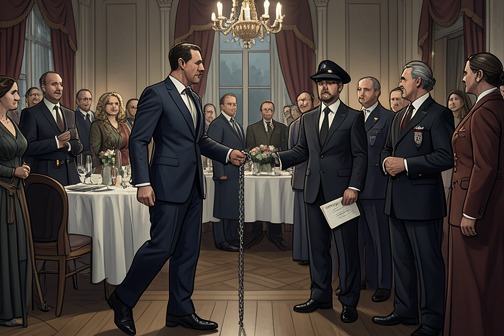
[Cui Feng](entity:character-recall-character-cui-feng-843c7ee06fee)’s arrest at the banquet is the decisive confrontation between [Li Yan](entity:character-recall-character-li-yan-3c97cde70b0f) and the man he suspects of murder: Li arrives armed and close to acting on his anger, but arrests Cui Feng under a warrant rather than taking revenge. Staged among officials and guests, the encounter makes the choice public. Cui Feng is led away in handcuffs, while Li’s restraint distinguishes the demand for justice from the impulse to punish him personally.
## Background and investigative stakes
The arrest comes after the investigation has raised questions about both the scale of the crimes and how they were carried out. In an earlier discussion, Li considers the possibility that the killer was mentally disturbed, in part because of the suspected operations on eighteen women and possibly more. [Dai](entity:character-recall-character-dai-7e08407cff8a) points out that administering [Midazolam](entity:object-recall-object-midazolam-30d3b85476cd) and operating an Ambu bag would have required another person’s involvement. Li accepts that the crimes may have been collaborative and redirects the detectives to their immediate task: identifying the victims. The exchange leaves the number of perpetrators unresolved, but broadens the investigation beyond the image of a solitary killer.
The inquiry also depends on recognizing what its accumulated details mean. After learning that [Chai Rui](entity:character-recall-character-chai-rui-ae87dc17efed), a twenty-two-year-old woman also known as Cherry, had a young daughter, Margaret Campbell reflects on how knowing a victim’s name and family changes the experience of examining the case. The fact that Chai Rui had given birth prompts Margaret to reconsider what the evidence might connect; she berates herself for allowing too much information to obscure what was obvious and describes her realization as the answer to a riddle. At the autopsy table, Li asks what obvious link she has missed. These scenes establish the investigators’ effort to read individual details together, although the evidence presented here does not state the full substance of Margaret’s discovery or establish it as the direct cause of the banquet arrest.
## The confrontation at the banquet
Shortly before Li reaches the banquet room, Dai reports by radio that American surgeon [Daniel F. Stein](entity:character-recall-character-daniel-f-stein-c7177b877dac) has been intercepted at the airport while trying to board an Air India flight to Delhi. Stein has a briefcase full of computer disks that may contain significant material. Li gives no audible response before the scene moves to the banquet, so the evidence does not specify what he knows about the airport interception at the moment he enters.
At the [Xiaoshaoxing Hotel](entity:location-recall-location-c610eb22a094), Li walks into the largest banquet room, where Cui Feng is seated beside [Director Hu](entity:character-recall-character-director-hu-2a0a2dc3e73a). The guests turn toward the unexpected arrival; Director Hu rebukes Li for appearing without an invitation and invokes his rank. Li does not answer. He draws [Huang’s Gun](entity:object-recall-object-498d2e7e175c) and points it at Cui Feng, moving through the room until he is within a metre of him. Cui Feng remains seated until Li is close, while the other guests recoil from the armed officer. The display of force shifts the gathering from a formal meal to a confrontation, but Li’s attention remains fixed on Cui Feng rather than on Director Hu or the surrounding guests.
Director Hu tells Li that his career is finished and orders him to put the gun down. Li ignores him and tells Cui Feng to stand. Cui Feng rises with apparent confidence, but notices that Li’s hand is trembling. His expression changes from arrogance to doubt and then fear. The narration presents Li as caught between the desire to end the confrontation by firing and the possibility of bringing Cui Feng to account through legal process; the two outcomes are not treated as equivalent.
## Arrest and its significance
Dai’s quiet call from the doorway interrupts the moment. He and [Qian](entity:character-recall-character-qian-1e940cf8a576) are present behind Li, and the appeal implicit in Dai’s address gives Li time to choose. Li takes folded official papers from his jacket and holds up the warrant. He announces that Cui Feng is being arrested on suspicion of murder, with the count beginning at fifty-four and likely to rise. The figure is presented as the scale of the suspicions set out in the warrant, not as a conviction or a final count.
Cui Feng smiles as if Li’s refusal to shoot has secured his advantage. Instead, Li has chosen an arrest and the authority of law over immediate revenge. Dai, Qian, and uniformed officers move past Li, handcuff Cui Feng, and lead him out. The officers’ action completes the arrest, but the encounter’s moral turning point is Li’s decision to present the warrant when he could still have fired. The scene does not resolve Cui Feng’s guilt in court; it establishes that he is now in custody on suspicion of a grave series of murders.
After the officers leave, the banquet room is silent. Li turns to Director Hu, whose presence beside Cui Feng has placed him within the scene of the arrest, but whose own legal status is not changed here. Li tells him to choose his friends more carefully, using the proverb, “[Marry a dog, stay with a dog; marry a rooster, stay with a rooster.](entity:expression-recall-expression-marry-a-dog-stay-w-361b9cd1f039)” The remark sharpens the scene’s institutional tension: Director Hu has tried to assert authority over Li, yet Li has acted against Cui Feng in front of him. The arrest therefore closes neither the investigation nor the question of complicity. It marks a consequential shift from a threatened act of personal vengeance to a public, warrant-based seizure, while leaving the evidence about the wider network to be pursued.